single bonds
Good afternoon! More than anything, I’m writing this so it doesn’t look like I poetically died in an aviation accident after my last post. It’s as good of an excuse as any other I use to ramble on here, so let’s get into a discussion of single bonds. If you’ve ever taken a chemistry class, you’re familiar with the concept, but I wanted to dig deeper into what a single bond actually is and — more specifically — what the concept of a single bond makes easier to know.
Let’s start from true first principles. An electron is a negatively-charged fundamental particle — these bad boys aren’t even composed of quarks — with nearly zero mass. A proton is positively-charged and substantially more massive, and a neutron has no charge but the same mass as a proton. Mass is one of the most obvious physical properties we perceive, even if we have no direct sense for it and judge it based on how an object with mass deflects our appendages, so it may come as a surprise to you that it is the electrons that make the major contribution to a given atomic species’ properties. This is largely because they determine the charge in a labile manner (protons determine it too, but you can’t plonk a proton off — usually) which makes it a semi-meaningless distinction, but it is still true. The charge and electron configuration of an atomic species determines the type of bonds it can reasonably make as well, and bonding determines much of the more complex properties of molecules. So, in a roundabout way, it is the electrons of an atom, not its nucleons, that give it real properties — at least outside of a particle accelerator, that is.
What even is one electron? Is it a particle, or a wave, or a waveparticle? Well, the entire point of this blogging series is “that is sort of a meaningless question,” so let’s start there; whatever it can be said to be, the one thing it should be said to be is an electron. It is an electron. An electron is a thing you can study without studying things other than an electron, making it possible to learn stuff about electrons, and the stuff we have learned is weird. But whatever you end up wanting to call it — wave, particle, waveparticle, whatever — you’re not talking about a waveparticle, or wave, or particle, you’re talking about an electron. Another way of putting the point I am awkwardly making is as follows: it is usually a bad idea to ask what something “is” if you want to really understand it. You must start from the perspective of a Planck-sized Jane Goodall, and ask what properties it has.
Electrons can have a velocity, a speed relative to space. They can also collide with eachother, and bounce off one another — the Pauli exclusion principle rigidifies this by observing that two electrons with the exact same properties cannot exist, where one of the properties is location — and they can be diffracted like light. Speaking of light, electrons boast a very fundamental relationship with photons: electrons can essentially “eat” photons for their energy, and can emit photons to release energy. This process, known as photoexcitation, forms the basis for countless physical and natural phenomena. Two of the biggest ones might be chemical sight (how we all see) and neon lighting. I know what you’re thinking — “neon lighting didn’t change the world!” — and I’m here to say, I don’t care. It’s dope as shit. Still, we’ve left the most important property of electrons for last, and that is there spin. Electron spin is described as angular momentum, but I’ve been told by people much smarter than me that it’s like… sort of a different sort of thing? I have no real idea, but just know that “electron spin” is yet another model. It’s a huge deal though. Spin is one of the fundamental properties of an electron covered under the Pauli exclusion principle, which means if two electrons have differing spin, they may occupy the exact same position in the atom’s orbitals. Oh, that reminds me: electrons do not “orbit” the nucleus, they inhabit orbits.
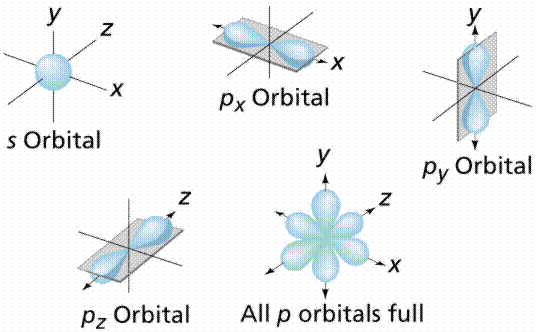
What you are looking at, most literally, are the zones in which you can expect to find an electron living. The s-shell is the smallest and closest to the nucleus; it can hold only two electrons. The p-shells — three of them — can hold two electrons each. In fact, for all of these, it is much more energetically favorable to hold two electrons! This is because, thanks to the Pauli exclusion principle (or whatever natural law it codifies), two electrons with opposite spins can hang out in the same orbital. When they do that, they cancel out eachother’s spin, and it is that that makes the 2e configuration more stable. Just to push the Pauli point though, the s and p orbitals do overlap eachother in space to some degree, and that causes no electron collision issues because it doesn’t violate Pauli’s principle. Still, this is all a model: lord knows what is actually going on in there. It doesn’t seem like a comfy place to be, at any rate.
Single Bonds
This is the part of the blog where I tell you they’re technically called sigma bonds; I just refuse to call them that in a public forum. Right away, the Wikipedia page begins strolling right up our alley by calling sigma bonds “sigma overlap” — this is exactly how they form. See, the s-shell always exists whether or not it is full. I seriously have no idea how to make that real to you, and I don’t think molecular orbital theory knows how either, but it’s very model-true and a required assumption to explain like 99% of all organic chemistry reactions in a molecular-orbital-based fashion. When the full s-shell (2 electrons) of one nucleus overlaps the empty s-shell of another nucleus, molecular orbital theory argues that both s-shells disappear and are replaced with a sigma shell that is the geometric average of the volume of the two former s-shells.
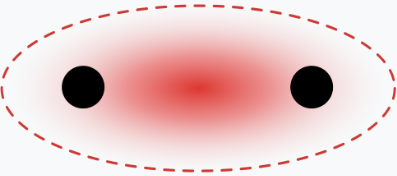
What is actually happening here? Well, the jig is up, folks. Nobody has any fucking clue. Seriously, molecular orbital theory is like thirty years old, predicts literally everything, and is still pretty much gibberish. It works in the same way general relativity did, which is “why the fuck does this work? Did the guy get spoken to by alien? Is this the nonsense model aliens teach to their eighth graders? Help me. Everything hurts.” Still, you’re looking at a strong, strong bond, and the degree to which HOMO/LUMO analysis predicts reactions suggests that atomic orbitals (that’s what the shells are called before hybridization) and molecular orbitals both have very real physical correlates, but how to square them directly into physical reality is still kind of difficult. I must drive home the point of correlation, though: a “double bond” involves the formation of one sigma bond and one pi bond (a future post, perhaps) while a triple bond involves one sigma bond and two pi bonds. p-shells become very important in chemistry writ large because they are an atom’s first option for forming higher-order bonds, supporting up to 3 more bonds on top of the sigma interaction, and the structure of the p-shells (which is a thing you can directly visualize — seriously, these electron density maps are very real, people just struggle to explain exactly why they occur in those shapes) explains exactly why that can happen. There’s three sets!
Don’t be so sure of the understandability of the universe, though — it is entirely possible to sequester “0.667” electrons into “one” bond. Hopefully, though, you can see more clearly now how that might be possible!